
For most families in Kenya, money from abroad ends up on a phone. “Just send it to M-Pesa” is the usual request, and plenty of apps and transfer companies will do it. What senders in the UK and the US are rarely told is that the recipient has to be registered for M-Pesa, that Safaricom publishes a lower cap for international transfers than for ordinary M-Pesa payments, and that the sending company can set its own limits on top. This guide sets out those rules from Safaricom’s own pages, next to the sender-side rules in each country.
This is general information, not financial, tax or legal advice. We do not rank providers or recommend one, and nothing here is a quote. Rules and figures were checked on 12 November 2026 against the sources listed at the end. Where we could not confirm a point from an official source, we say so in the text.
Last updated 12 November 2026. This piece sits in the Protect section.
The short answer
Use a formal channel: a bank or a regulated money-transfer provider. Compare the shillings the recipient will actually receive, not the headline fee. For an M-Pesa payout, check the recipient is registered for M-Pesa; if they are not, Safaricom says they get an SMS and have 21 days to register to access the money. Safaricom says the most that can be sent at any one time through international money transfer is approximately KSh 70,000, and that daily, monthly or yearly limits depend on the country and the partner. Check the provider is authorised (the FCA Register in the UK, the written disclosure before you pay in the US), and remember that a 1% US tax applies if you pay for the transfer in cash.
How big this corridor is
The World Bank reports that Kenya received about US$5.11 billion in personal remittances in 2025, up from about US$5.00 billion in 2024. The series covers money sent from every country, not only the UK and US, and we did not find a UK or US share in the same data.
How the money can reach Kenya
| Route | What the recipient needs | What to check before you send |
|---|---|---|
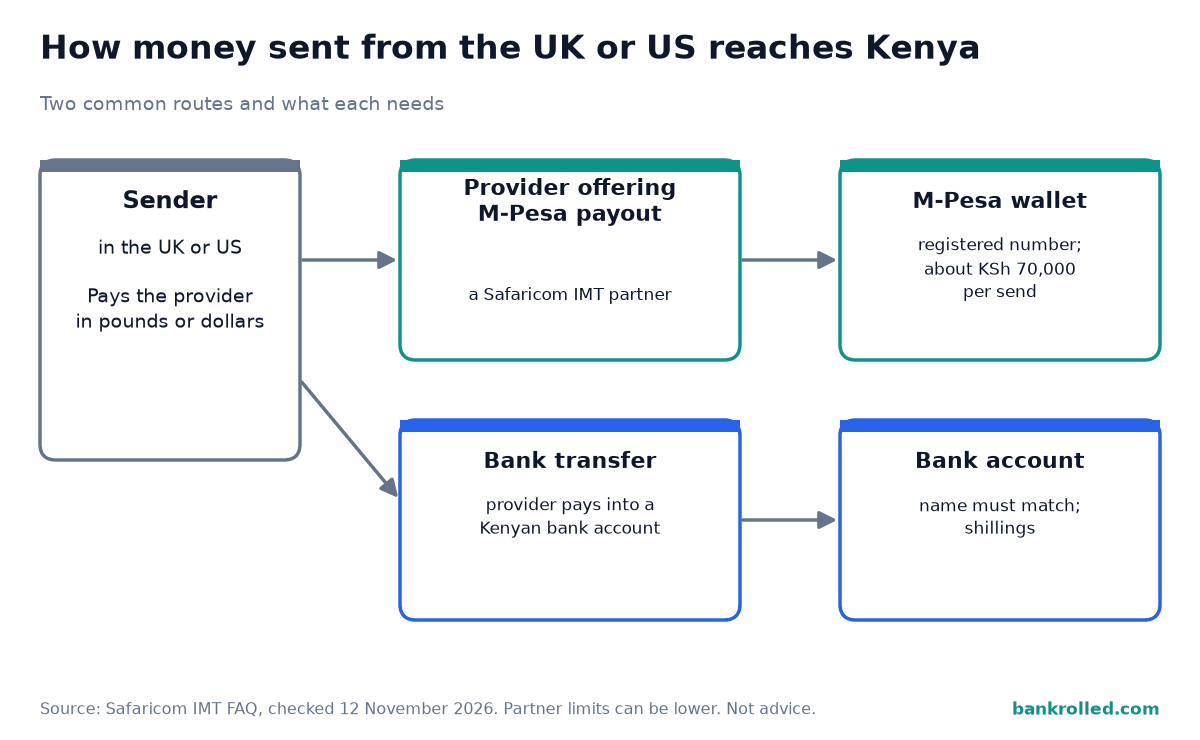
| M-Pesa (mobile money) | A Safaricom line registered for M-Pesa; the sender gives the mobile number | That the recipient is registered, the approximate KSh 70,000 per-send cap, and any limit your provider sets |
| Bank account deposit (shillings) | The account name exactly as the bank holds it, the bank and the account details your provider’s form asks for | That the name matches exactly; any charge the receiving bank makes, which we did not check |
| Cash pickup | ID and the transfer reference, if the provider offers it | The pickup point, the ID it accepts and any limit; we did not check cash pickup rules |
Payout times depend on the provider and the route, so use the speed the provider shows you for your exact transfer.
Before you send to M-Pesa
This is the part most comparison pages skip. Three things decide whether an M-Pesa transfer from abroad lands smoothly: registration, the international cap and the ordinary M-Pesa caps.
The recipient must be registered, or register within 21 days
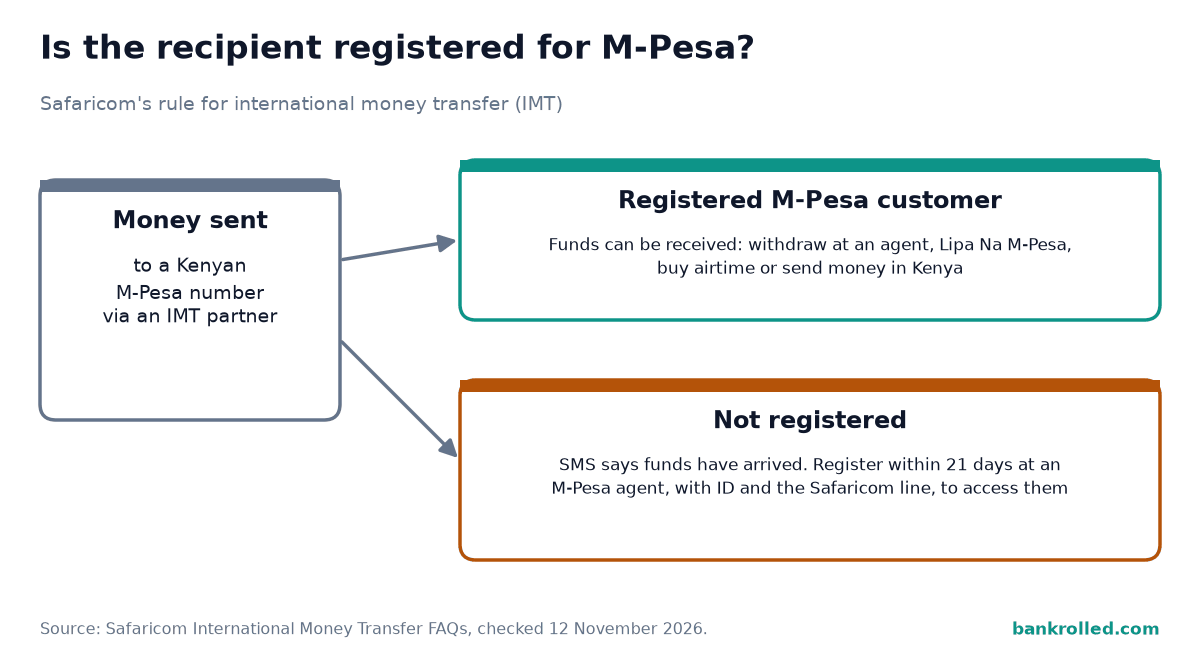
Safaricom’s international money transfer (IMT) FAQ says the sender visits a Safaricom IMT partner and sends to an M-Pesa mobile number in Kenya. “The sender does not have to be a registered M-PESA customer.” But “you must be a Safaricom subscriber to receive funds through M-PESA IMT”. If the recipient is not registered, Safaricom says they will get an SMS confirming funds have arrived, and they “need to register within 21 days to access the funds” at an M-Pesa agent, with their identification documents and their Safaricom line. The FAQ does not say what happens after 21 days, so if your recipient is not registered, ask them to register before you send.
Safaricom’s published limits
| Limit | Figure | Where Safaricom publishes it |
|---|---|---|
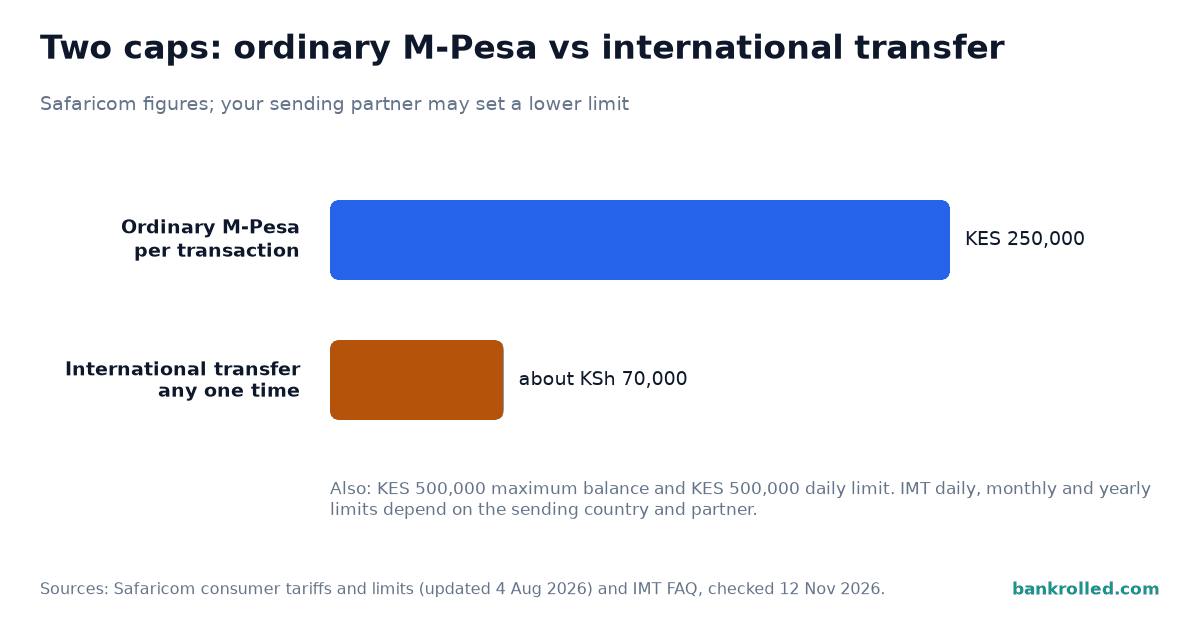
| International money transfer, any one time | Approximately KSh 70,000 | IMT FAQ |
| International transfer limits per day, month or year | Depend on the sending country and the partner | IMT FAQ |
| Maximum amount per M-Pesa transaction | KES 250,000 | Consumer tariffs and limits page |
| Maximum daily transaction limit | KES 500,000 | Consumer tariffs and limits page |
| Maximum M-Pesa account balance | KES 500,000 | Consumer tariffs and limits page |
The international figure is the one that usually matters for a sender. Safaricom itself calls it approximate and says “the sender shall be advised by the preferred Partner on any applicable restriction”, so treat KSh 70,000 as a guide, not an exact line, and follow the limit your provider shows you. The ordinary caps still matter after the money arrives: a recipient close to the KES 500,000 balance cap may not have room for a large transfer. Safaricom’s customer terms also say it may prescribe transaction limits subject to Central Bank of Kenya approval and “may allocate some M-PESA Accounts with higher or lower limits”. Safaricom does not publish separate basic and fully verified receiving limits, so we do not invent any.
Registration ID
Safaricom’s tariffs page says M-Pesa registration at agent outlets is available only to customers presenting a Kenyan National ID or Kenyan Passport. Customers using a foreign passport, military ID or foreigner certificate can register at a Safaricom Shop or Customer Care Desk. For cash deposits and withdrawals, it accepts a Kenyan National ID, Kenyan Passport, foreign passport, military ID or foreigner certificate.
Who Safaricom lists as partners
The IMT FAQ says Safaricom “has so far partnered with” a list of authorised international money transfer organisations, and names nine. The list may not be complete or current: at least one large provider describes M-Pesa payouts on its own Kenya page but is not named there. So check that the provider you use offers an M-Pesa payout in the quote itself. The FAQ also says partners are registered with their regulators for anti-money-laundering compliance, that Safaricom screens senders and receivers as required by law, and that senders may be asked for proof of ID.
What it really costs
Fees are only part of the price. The exchange rate the provider uses is the other part. Safaricom says charges vary with the amount, the sending country and the partner, and that each partner advises the sender of charges before the money is sent; conversion is done when the funds are sent. The mid-market rate is the rate banks use with each other, which you can see on a currency converter. The gap between that and the rate you are given is a cost.
The US Treasury quotes World Bank estimates in the Federal Register: for US$200 and US$500 remittance transfers sent from the United States in 2025, the average transaction fee was 5.56% and 3.81% of the amount, respectively. Those are global averages for sends from the US, not a price for Kenya and not a quote.
To compare offers:
- Write down the exact number of shillings the recipient will receive after all fees.
- Look up the mid-market rate at the same moment.
- Divide shillings received by the mid-market rate. The difference from what you sent is your real cost.
Illustration (invented numbers, not a quote). You send 400. The mid-market rate is 170 shillings per unit, so a perfect transfer delivers 68,000 shillings. Offer A charges a fee of 3 and uses a rate of 168, so the recipient gets 397 × 168 = 66,696 shillings, a cost of 1,304 shillings or about 1.9%. Offer B has no fee but uses a rate of 166, so the recipient gets 66,400 shillings, a cost of 1,600 shillings or about 2.4%. The “no fee” offer is the dearer one. Note too that 68,000 shillings is already close to Safaricom’s approximate KSh 70,000 per-send figure, so for a larger amount, check the limit your provider shows or consider a bank payout.
Bankrolled may earn a commission if you sign up through this link. It does not change the product or price.
Two quotes to compare. Wise and Instarem both list transfers from the UK to Kenya (GBP to KES) on their UK sites. Price the same amount with each on the same day, run the steps above on both, and keep the one that delivers more shillings. Wise’s Kenya page lists M-PESA and local bank account payouts. Instarem’s Kenya page does not say whether it pays into M-Pesa, so check the payout options in its quote. This is not a ranking: Bankrolled has affiliate links with both, and other regulated providers may be cheaper for your amount. Price a transfer with Instarem, then check Wise below. In the UK, Instarem is a brand operated by Nium Fintech Limited, which the Financial Conduct Authority authorises to issue electronic money and provide payment services (reference 901024). That makes it an e-money firm, not a bank. Instarem’s other countries have other entities, so check the one that serves yours (UK pages checked 12 November 2026).
Sending from the UK: checks
- Check the firm is authorised. The FCA says non-bank payment providers, such as authorised payment institutions, small payment institutions and electronic money institutions, must be authorised or registered. Search the FCA Financial Services Register by the provider’s legal company name.
- Know what is protected. The FCA says there is no Financial Services Compensation Scheme cover for these firms. Electronic money institutions and authorised payment institutions must safeguard customer money; small payment institutions do not have to.
- Complaints. Complain to the provider first. If you are unhappy with the answer, you can go to the Financial Ombudsman Service.
- Money transfer businesses must be registered with HMRC under the Money Laundering Regulations.
- Cancelling. Under regulation 83 of the Payment Services Regulations 2017, a payment order generally cannot be revoked once your provider has received it, unless you agree otherwise with the provider. Check the provider’s terms before you pay.
Sending from the US: checks and rights
The 1% remittance tax applies only to some payments
The IRS says that beginning 1 January 2026, a 1% remittance transfer tax applies to remittances sent from the United States when the sender provides cash, a money order, a cashier’s check or another similar physical instrument to the provider. The sender is liable for the tax and the provider collects it. On US$500 paid in cash the tax would be US$5.
These are still proposed regulations. Comments were due on 12 June 2026, and we found no final regulations when we checked on 12 November 2026. IRS Notice 2026-52 extends penalty relief for remittance transfer providers until final regulations apply.
What a US provider must show you
Under the CFPB’s remittance rule (Regulation E, subpart B), before you pay, the provider must show the amount transferred, its fees and any taxes, the total, the exchange rate, and the amount the recipient will get. Your receipt adds the date the money will be available, your error and cancellation rights, and contact details for the provider and regulators.
Cancelling and errors
- Cancel. The CFPB says you can cancel at no cost if the money has not been picked up or deposited, you paid less than 30 minutes ago, and you gave enough information for the provider to find the transfer. A scheduled transfer can be cancelled up to three business days before it is made.
- Errors. Tell the provider within 180 days of the date it disclosed the money would be available. It must investigate within 90 days of your notice and then report the result to you.
- Wrong account. If you gave an incorrect account number, the transfer may not count as an error under section 1005.33, so you could lose the money. Check the M-Pesa number twice.
Receiving in Kenya: what the recipient should check
The recipient should make sure their Safaricom line is registered for M-Pesa and active, and that the number you have is the one registered. Before a large transfer, they should check their balance against the KES 500,000 cap. Safaricom says money received through IMT can be withdrawn at any M-Pesa agent, or used to pay with Lipa Na M-Pesa, buy airtime or send money to other subscribers in Kenya. Safaricom’s tariff page lists the charges for withdrawals and transfers inside Kenya, which are separate from what you pay to send. Tell your recipient to keep the confirmation SMS and transfer reference, and to contact the provider if a payment is delayed.
If you are a freelancer in Kenya paid from the UK or US
If you live in Kenya and clients abroad pay you, see our guides to getting paid in one country while you live in another, the payout fee stack on a US$2,000 payment, why a USD payment can arrive short and the W-8BEN. For tax residence, see tax residence versus where your client is, and for money held across borders, moving money across borders without a UK bank.
Safe-sending checklist
- Is the company on the FCA Register (UK), or does it give the US disclosure before you pay?
- Does the quote show the exact shillings the recipient will receive?
- Is the recipient registered for M-Pesa, and is the number you have the registered one?
- Will this amount fit the IMT per-send cap, your provider’s limit and the recipient’s KES 500,000 balance cap?
- Does your provider actually offer an M-Pesa payout for your transfer?
- Did you pay in a way that avoids the 1% US tax, where that applies?
- Did someone ask you to pay into new bank details? Check using our guide on checking a change of bank details before you pay.
- Have you kept the receipt and reference number?
If a bank closes your account because you live abroad, see what to do when a bank closes your account. For where to keep emergency money, see deposit protection abroad. Other corridors: India, Pakistan and the Philippines.
Frequently asked questions
Can I send money from the UK or US straight to an M-Pesa number?
Yes. Safaricom says anyone can send through a Safaricom IMT partner to an M-Pesa mobile number in Kenya, and the sender does not need to be an M-Pesa customer. Check that your provider offers an M-Pesa payout in its quote.
Does the recipient have to be registered for M-Pesa?
Yes, to receive funds. If they are not registered, Safaricom says they will get an SMS and must register within 21 days at an M-Pesa agent to access the funds.
What are Safaricom’s M-Pesa limits?
On Safaricom’s consumer tariffs page: a maximum balance of KES 500,000, a maximum daily transaction limit of KES 500,000 and a maximum of KES 250,000 per transaction.
Is the international transfer limit different?
Yes. Safaricom’s IMT FAQ says the maximum that can be sent at any one time via M-Pesa is approximately KSh 70,000, lower than the ordinary per-transaction cap.
Can the sending company set its own limits?
Yes. Safaricom says daily, monthly or yearly limits depend on the country and the partner the money is sent from, and that the partner tells the sender about any restriction.
What ID does Safaricom ask for at registration?
At agents, a Kenyan National ID or Kenyan Passport. Holders of a foreign passport, military ID or foreigner certificate register at a Safaricom Shop or Customer Care Desk.
How do I compare providers without a ranking?
Get quotes for the same amount at the same time, write down the shillings the recipient receives after all fees, and compare each with the mid-market rate. A low fee with a poor rate can cost more than a higher fee with a good rate.
What rights do I have as a sender?
In the UK, use an FCA-authorised or registered firm; there is no FSCS cover, and complaints go to the firm and then the Financial Ombudsman Service. In the US, you get a written disclosure before you pay, can generally cancel free within 30 minutes, and have 180 days to report an error. A 1% US tax applies only to cash-type funding.
Why might an M-Pesa transfer fail or be held?
Common reasons are an unregistered or wrong number, an amount above the international cap or the provider’s limit, a recipient near the balance cap, or anti-money-laundering checks, which Safaricom says can include screening and proof of ID.
I am a freelancer in Kenya paid from abroad. Where do I start?
See the freelancer section above, which links to our guides on getting paid across borders, payout fees and the W-8BEN.
What this guide does not cover
It is not tax, legal or financial advice. We have not listed named providers’ fees, speeds or limits, because they change often and we did not check any provider’s fee page for this edition; the method above shows how to compare live quotes. We did not find the Central Bank of Kenya document behind Safaricom’s limits, check bank receiving charges or cash pickup rules, or check other Kenyan wallets. We do not cover sending money out of Kenya, including M-Pesa Global sending from Kenya, Kenyan tax on money received, informal channels, crypto, or business payments.
Sources
- World Bank: Personal remittances, received (current US$), Kenya, data last updated 8 October 2026, checked 12 November 2026
- Safaricom: International Money Transfer FAQs, checked 12 November 2026
- Safaricom: M-Pesa consumer tariffs and limits, last updated 4 August 2026, checked 12 November 2026
- Safaricom: M-Pesa customer terms and conditions, clause 7.6, checked 12 November 2026
- IRS: Treasury, IRS issue proposed regulations on the new remittance transfer tax, checked 12 November 2026
- IRS Notice 2026-52, extending penalty relief for remittance transfer providers, checked 12 November 2026
- Federal Register: Excise Tax on Remittance Transfers, 13 April 2026, checked 12 November 2026
- CFPB: Can I cancel an international money transfer?, last reviewed 3 October 2024, checked 12 November 2026
- CFPB: Regulation E section 1005.31, disclosures, checked 12 November 2026
- CFPB: Regulation E section 1005.33, procedures for resolving errors, checked 12 November 2026
- FCA: Using payment service providers, page last updated 8 January 2026, checked 12 November 2026
- FCA Financial Services Register, checked 12 November 2026
- legislation.gov.uk: Payment Services Regulations 2017, regulation 83 (revocation of a payment order), checked 12 November 2026
- GOV.UK: Money laundering regulations, who needs to register, checked 12 November 2026
- Financial Ombudsman Service, checked 12 November 2026
- Instarem UK: Send money to Kenya (GBP to KES; FCA authorisation notice for Nium Fintech Limited, reference 901024), checked 12 November 2026
- Wise UK: Send money to Kenya (GBP to KES; M-PESA and bank payouts listed), checked 12 November 2026
Still got a question? Ask Bankrolled and get a quick answer from our guides.
