
Bangladesh is one of the biggest remittance corridors in the world, and much of that money now lands in a mobile wallet rather than a bank. If a relative has given you their bKash or Nagad number, finding a way to send is easy. The harder questions are whether the amount will be accepted, whether the wallet can then take other payments, and how much the recipient can actually cash out. This guide answers those for senders in the UK and the US, using bKash’s and Nagad’s own published limits and the sender-side rules in each country.
This is general information, not financial, tax or legal advice. We do not rank providers or recommend one, and nothing here is a quote. Rules and figures were checked on 12 November 2026 against the sources listed at the end. Where we could not confirm a point from an official source, we say so in the text.
Last updated 12 November 2026. This piece sits in the Protect section.
The short answer
Use a formal channel: a bank or a regulated money-transfer provider. Compare the taka the recipient will actually receive, not the headline fee. Before a large transfer to a wallet, ask the recipient to check three limits. On bKash’s official limits page, one international remittance can be up to BDT 250,000. Remittance is exempt from the ordinary BDT 500,000 wallet balance cap, but above that balance the wallet stops taking most other credits. And cash-out is capped at BDT 30,000 a day and BDT 200,000 a month. Check the provider is authorised (the FCA Register in the UK, the written disclosure before you pay in the US), and remember that a 1% US tax applies if you pay for the transfer in cash.
How big this corridor is
The World Bank reports that Bangladesh received about US$33.88 billion in personal remittances in 2025, up from about US$27.52 billion in 2024. The series covers money sent from every country, not only the UK and US, and we did not find a UK or US share in the same data.
How the money can reach Bangladesh
| Route | What the recipient needs | What to check before you send |
|---|---|---|
| bKash wallet | A registered, valid bKash account, and the full name exactly as given when it was opened | The BDT 250,000 per-transaction cap, the balance catch above BDT 500,000 and the cash-out caps; that your provider pays out to bKash |
| Nagad wallet | A Nagad account in the recipient’s own name | Nagad’s remittance limits (below), and that your provider pays out to Nagad; we did not find a Nagad partner list |
| Bank account deposit (taka) | The account name exactly as the bank holds it, the bank and the account details your provider’s form asks for | That the name matches exactly; any charge the receiving bank makes, which we did not check |
| Cash pickup | ID and the transfer reference, if the provider offers it | The pickup point, the ID it accepts and any limit the provider sets; we did not check cash pickup rules |
Payout times depend on the provider and the route, so use the speed the provider shows you for your exact transfer.
Before you send to bKash
A remittance can arrive in full and still be awkward to use, so the recipient should check these points before anyone sends a large sum.
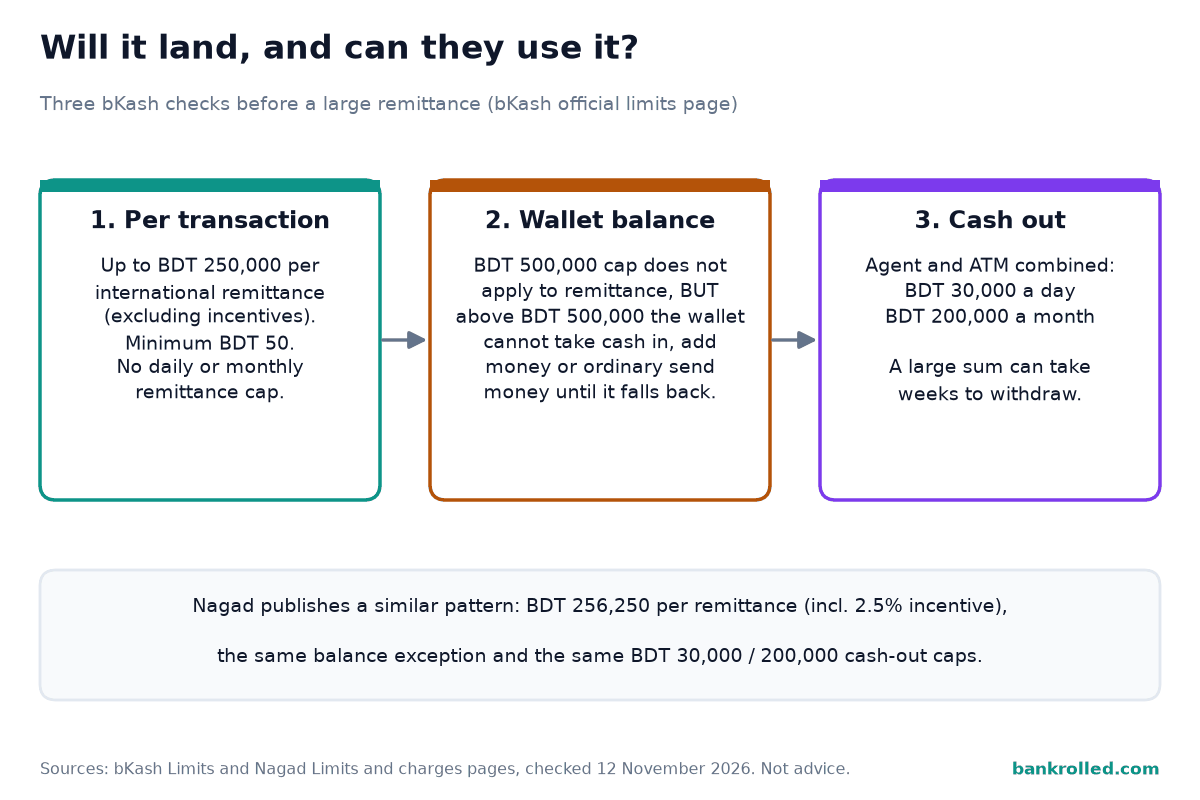
bKash’s published limits
| Limit on bKash’s official page | Figure |
|---|---|
| International remittance, per transaction | Minimum BDT 50; maximum BDT 250,000, excluding government and bank incentives |
| International remittance, count and total per day or month | No limit |
| Payoneer (listed as international remittance) | Minimum BDT 1,000; maximum BDT 250,000 |
| Maximum wallet balance | BDT 500,000, with the remittance exception below |
| Cash out, agent and ATM combined | BDT 30,000 a day and BDT 200,000 a month |
The page does not split these limits into basic and fully verified accounts, so we do not either. If a recipient’s app shows a different figure, the app is the better guide for their account.
The balance catch
bKash says that in the case of remittance, the condition of keeping a maximum balance of BDT 500,000 “is not applicable”. However, customers “cannot add or receive any kind of money including Cash In/Add Money/Send Money Receive into their bKash accounts until the account balance drops below BDT 500,000 (except Remittance and Government disbursement)”. So a large remittance can push a wallet over BDT 500,000, and the recipient then cannot receive ordinary payments from people in Bangladesh until they spend or move money out. With cash-out capped at BDT 30,000 a day, that can take a while. (bKash says remittance cash-outs at BRAC Bank, City Bank and Q-Cash ATMs cost 7 taka per thousand.) A bank account may suit a large one-off sum better; the recipient can tell you.
Name and number must match
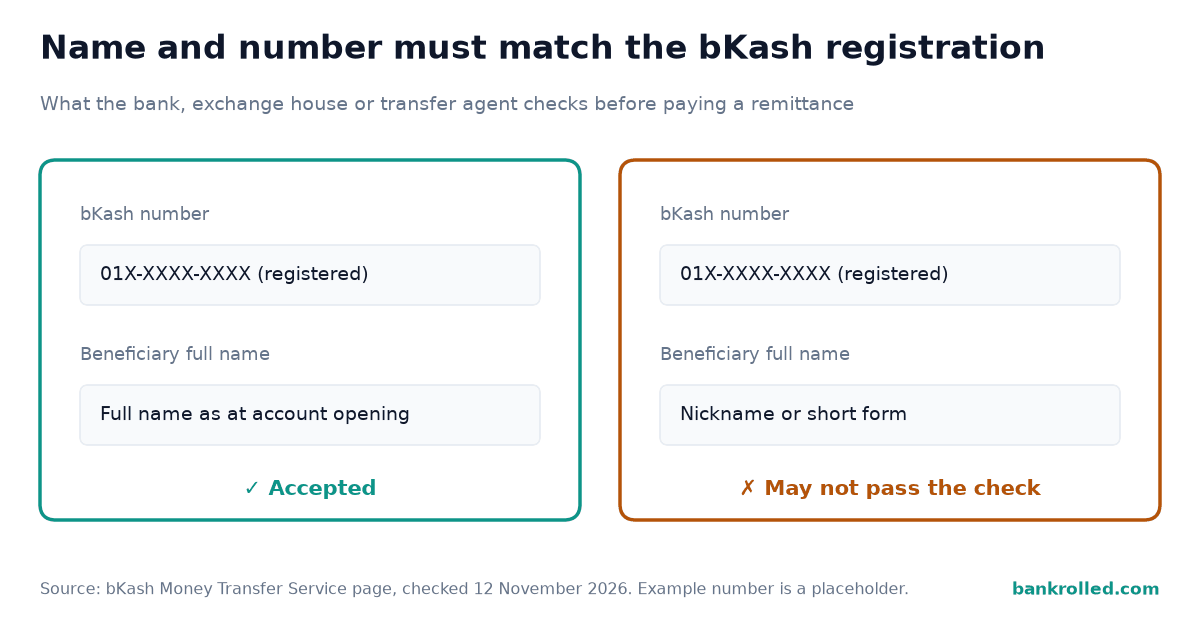
bKash’s remittance page says the sender gives the beneficiary’s bKash account number and full name “as mentioned during bKash Account Opening”. The bank, exchange house or transfer agent checks that the beneficiary has a registered and valid bKash account, that the number and name are accurate, and that the amount in taka does not exceed the limit. Ask the recipient to send you their name exactly as it appears on their bKash account, not a nickname.
Who bKash lists as remittance partners
bKash says remittances to bKash accounts come through “authorized and listed” foreign banks, money transfer organisations and money exchange houses, and publishes a country-by-country list on its remittance page. In our copy of the page some country labels did not display, so check the row for the country you are sending from on the day you send. The list is not a ranking and it changes.
The government incentive
bKash’s limits page says a “2.5% government incentive will be added to the remittance with every transaction and in some circumstances bank-provided incentives may also be added”. Its remittance page says recipients get the 2.5% government incentive “and in some cases, 2.5% bank incentive”. That is what bKash publishes; it is not a promise from us, it is not tax advice, and incentive schemes can change. We did not find the Bangladesh Bank circular behind these figures, so we do not attribute the limits or the incentive to one.
Nagad
Nagad publishes its own limits. On its official limits page, checked 12 November 2026, remittance has a maximum of BDT 256,250 per transaction, BDT 1,000,000 a day across up to 50 transactions, and BDT 5,000,000 a month across up to 200 transactions. Each of those figures is stated as including the 2.5% government incentive (BDT 256,250 is BDT 250,000 plus 2.5%). Cash-out is capped at BDT 30,000 a day and BDT 200,000 a month, and the maximum balance is BDT 500,000.
Nagad describes the same balance catch as bKash: the BDT 500,000 cap does not apply to inward remittance, but other credits stop until the balance falls below BDT 500,000, while remittances and disbursements can still be received within the transaction limits. The page also carries a note that “this increased limit will remain effective until 30 May 2026”, a date that has passed, and it does not say which limit the note refers to. So ask the recipient to confirm the figure in their Nagad app before a large transfer. We did not find a Nagad list of sending partners.
What it really costs
Fees are only part of the price. The exchange rate the provider uses is the other part. The mid-market rate is the rate banks use with each other, which you can see on a currency converter. The gap between that and the rate you are given is a cost.
The US Treasury quotes World Bank estimates in the Federal Register: for US$200 and US$500 remittance transfers sent from the United States in 2025, the average transaction fee was 5.56% and 3.81% of the amount, respectively. Those are global averages for sends from the US, not a price for Bangladesh and not a quote.
To compare offers:
- Write down the exact number of taka the recipient will receive after all fees.
- Look up the mid-market rate at the same moment.
- Divide taka received by the mid-market rate. The difference from what you sent is your real cost.
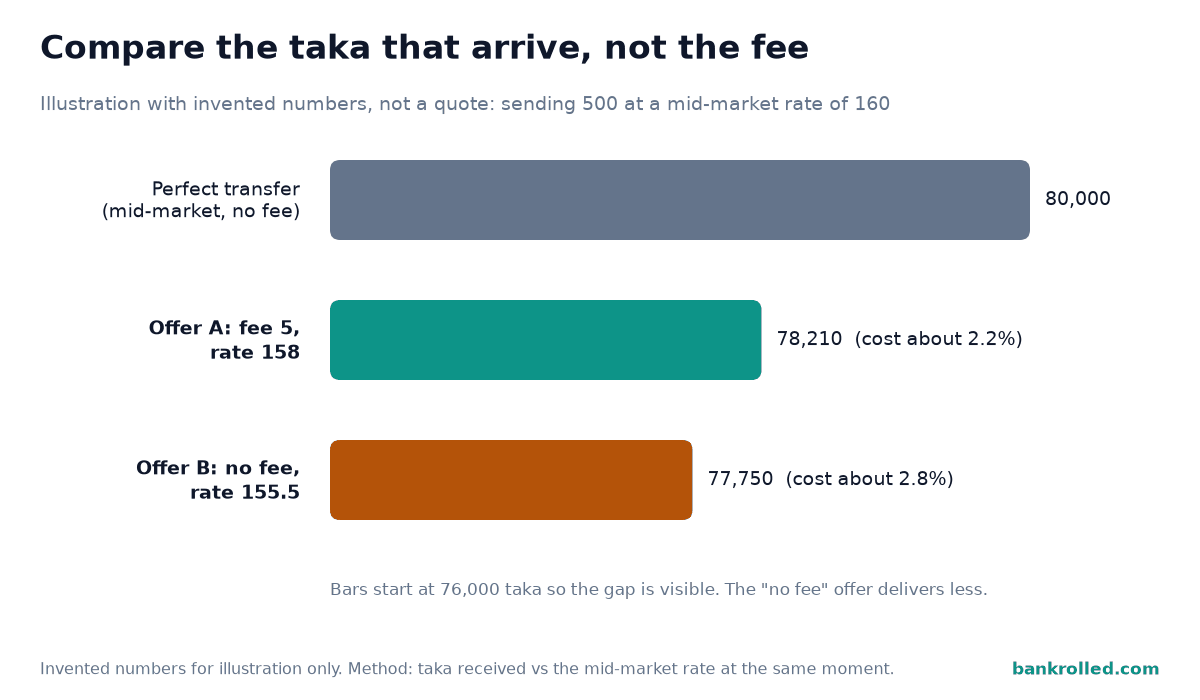
Illustration (invented numbers, not a quote). You send 500. The mid-market rate is 160 taka per unit, so a perfect transfer delivers 80,000 taka. Offer A charges a fee of 5 and uses a rate of 158, so the recipient gets 495 × 158 = 78,210 taka, a cost of 1,790 taka or about 2.2%. Offer B has no fee but uses a rate of 155.5, so the recipient gets 77,750 taka, a cost of 2,250 taka or about 2.8%. The “no fee” offer is the dearer one. Any government incentive is added on top and does not change which offer is cheaper.
Bankrolled may earn a commission if you sign up through this link. It does not change the product or price.
Two quotes to compare. Wise and Instarem both list transfers from the UK to Bangladesh (GBP to BDT) on their UK sites. Price the same amount with each on the same day, run the steps above on both, and keep the one that delivers more taka. Wise’s Bangladesh page describes bank payouts, and Wise appears on bKash’s partner list for many countries; Instarem’s page does not say whether it pays into bKash or Nagad. If the recipient wants the money in a wallet, check that option appears in the quote before you pay. This is not a ranking: Bankrolled has affiliate links with both, and other regulated providers may be cheaper for your amount. Price a transfer with Instarem, then check Wise below. In the UK, Instarem is a brand operated by Nium Fintech Limited, which the Financial Conduct Authority authorises to issue electronic money and provide payment services (reference 901024). That makes it an e-money firm, not a bank. Instarem’s other countries have other entities, so check the one that serves yours (UK pages checked 12 November 2026).
Sending from the UK: checks
- Check the firm is authorised. The FCA says non-bank payment providers, such as authorised payment institutions, small payment institutions and electronic money institutions, must be authorised or registered. Search the FCA Financial Services Register by the provider’s legal company name.
- Know what is protected. The FCA says there is no Financial Services Compensation Scheme cover for these firms. Electronic money institutions and authorised payment institutions must safeguard customer money; small payment institutions do not have to.
- Complaints. Complain to the provider first. If you are unhappy with the answer, you can go to the Financial Ombudsman Service.
- Money transfer businesses must be registered with HMRC under the Money Laundering Regulations.
- Cancelling. Under regulation 83 of the Payment Services Regulations 2017, a payment order generally cannot be revoked once your provider has received it, unless you agree otherwise with the provider. Check the provider’s terms before you pay.
Sending from the US: checks and rights
The 1% remittance tax applies only to some payments
The IRS says that beginning 1 January 2026, a 1% remittance transfer tax applies to remittances sent from the United States when the sender provides cash, a money order, a cashier’s check or another similar physical instrument to the provider. The sender is liable for the tax and the provider collects it. On US$500 paid in cash the tax would be US$5.
These are still proposed regulations. Comments were due on 12 June 2026, and we found no final regulations when we checked on 12 November 2026. IRS Notice 2026-52 extends penalty relief for remittance transfer providers until final regulations apply.
What a US provider must show you
Under the CFPB’s remittance rule (Regulation E, subpart B), before you pay, the provider must show the amount transferred, its fees and any taxes, the total, the exchange rate, and the amount the recipient will get. Your receipt adds the date the money will be available, your error and cancellation rights, and contact details for the provider and regulators.
Cancelling and errors
- Cancel. The CFPB says you can cancel at no cost if the money has not been picked up or deposited, you paid less than 30 minutes ago, and you gave enough information for the provider to find the transfer. A scheduled transfer can be cancelled up to three business days before it is made.
- Errors. Tell the provider within 180 days of the date it disclosed the money would be available. It must investigate within 90 days of your notice and then report the result to you.
- Wrong account. If you gave an incorrect account number, the transfer may not count as an error under section 1005.33, so you could lose the money. Check the wallet number and registered name twice.
Receiving in Bangladesh: what the recipient should check
For a wallet payout, the recipient’s registered name and number must match what you give the provider. Before a large transfer, they should look at their current balance: if the remittance takes the wallet above BDT 500,000, other credits stop until the balance falls, and cash-out is limited to BDT 30,000 a day on both bKash and Nagad. For a bank payout, the name should match the account exactly. Tell your recipient to keep the transfer reference and contact the provider if a payment is delayed. bKash says remittance statements can be requested in its app.
If you are a freelancer in Bangladesh paid from the UK or US
If you live in Bangladesh and clients abroad pay you, see our guides to getting paid in one country while you live in another, the payout fee stack on a US$2,000 payment, why a USD payment can arrive short and the W-8BEN. For tax residence, see tax residence versus where your client is, and for money held across borders, moving money across borders without a UK bank.
Safe-sending checklist
- Is the company on the FCA Register (UK), or does it give the US disclosure before you pay?
- Does the quote show the exact taka the recipient will receive?
- Has the recipient confirmed their remittance and cash-out limits, and that the amount fits?
- Will this transfer take a wallet above BDT 500,000? If so, would a bank account suit them better?
- Does the name you entered match the recipient’s bKash or Nagad registration exactly?
- Does your provider actually offer a payout to that wallet?
- Did you pay in a way that avoids the 1% US tax, where that applies?
- Did someone ask you to pay into new bank details? Check using our guide on checking a change of bank details before you pay.
- Have you kept the receipt and reference number?
If a bank closes your account because you live abroad, see what to do when a bank closes your account. For where to keep emergency money, see deposit protection abroad. Other corridors: India, Pakistan and the Philippines.
Frequently asked questions
Can money from the UK or US go straight into a bKash wallet?
Yes, through a bank, exchange house or money transfer organisation on bKash’s list of authorised partners. bKash publishes that list by country on its remittance page. Check the row for your country, and check that your provider offers a bKash payout in the quote.
What is the bKash remittance limit?
bKash’s official limits page gives a maximum of BDT 250,000 per international remittance, excluding government and bank incentives, with a minimum of BDT 50 and no limit on the number or total of remittances per day or month.
Does the BDT 500,000 balance cap apply to remittance?
No, according to bKash. But once the balance is above BDT 500,000, the wallet cannot receive other kinds of money, such as cash in, add money or ordinary send money, until the balance drops below that figure. Remittances and government disbursements can still come in.
How much can the recipient cash out?
On bKash, up to BDT 30,000 a day and BDT 200,000 a month from agents and ATMs combined. Nagad publishes the same daily and monthly cash-out caps.
What details does the recipient need to give me?
Their wallet number and their full name exactly as registered when the account was opened. For a bank payout, the account name exactly as the bank holds it and the account details your provider asks for.
Will the recipient get the 2.5% government incentive?
bKash says a 2.5% government incentive is added to remittances, and in some cases a bank incentive too. That is bKash’s statement, not a promise from us, and schemes can change. Nagad’s limits are stated as including the 2.5% incentive.
What are Nagad’s remittance limits?
Nagad’s official page gives BDT 256,250 per transaction, BDT 1,000,000 a day and BDT 5,000,000 a month, each including the 2.5% government incentive. A note on the page refers to an increased limit effective until 30 May 2026, so ask the recipient to confirm the current figure in their app.
Is there a US tax on sending money to Bangladesh?
A 1% federal tax applies only when you fund the transfer with cash, a money order, a cashier’s check or a similar physical instrument. The sender is liable. The regulations were still proposed when we checked.
Can I cancel a transfer from the US?
Generally yes, at no cost, within 30 minutes of paying if the money has not been picked up or deposited. You also have 180 days to report an error. In the UK, a payment order generally cannot be revoked once your provider has received it; complain to the provider and then the Financial Ombudsman Service.
How do I compare providers without a ranking?
Get quotes for the same amount at the same time, write down the taka the recipient receives after all fees, and compare each with the mid-market rate.
I am a freelancer in Bangladesh paid from abroad. Where do I start?
See the freelancer section above, which links to our guides on getting paid across borders, payout fees and the W-8BEN.
What this guide does not cover
It is not tax, legal or financial advice. We have not listed named providers’ fees, speeds or limits, because they change often and we did not check any provider’s fee page for this edition; the method above shows how to compare live quotes. We did not find the Bangladesh Bank circulars behind the wallet limits, check bank receiving charges or cash pickup rules, or find a Nagad partner list. We do not cover sending money out of Bangladesh, Bangladeshi tax on money received, informal channels, crypto, or business payments.
Sources
- World Bank: Personal remittances, received (current US$), Bangladesh, data last updated 8 October 2026, checked 12 November 2026
- bKash: Limits, checked 12 November 2026
- bKash: Money Transfer Service (remittance, partner list, incentive), checked 12 November 2026
- Nagad: Limits and charges, checked 12 November 2026
- IRS: Treasury, IRS issue proposed regulations on the new remittance transfer tax, checked 12 November 2026
- IRS Notice 2026-52, extending penalty relief for remittance transfer providers, checked 12 November 2026
- Federal Register: Excise Tax on Remittance Transfers, 13 April 2026, checked 12 November 2026
- CFPB: Can I cancel an international money transfer?, last reviewed 3 October 2024, checked 12 November 2026
- CFPB: Regulation E section 1005.31, disclosures, checked 12 November 2026
- CFPB: Regulation E section 1005.33, procedures for resolving errors, checked 12 November 2026
- FCA: Using payment service providers, page last updated 8 January 2026, checked 12 November 2026
- FCA Financial Services Register, checked 12 November 2026
- legislation.gov.uk: Payment Services Regulations 2017, regulation 83 (revocation of a payment order), checked 12 November 2026
- GOV.UK: Money laundering regulations, who needs to register, checked 12 November 2026
- Financial Ombudsman Service, checked 12 November 2026
- Instarem UK: Send money to Bangladesh (GBP to BDT; FCA authorisation notice for Nium Fintech Limited, reference 901024), checked 12 November 2026
- Wise UK: Send money to Bangladesh (GBP to BDT), checked 12 November 2026
Still got a question? Ask Bankrolled and get a quick answer from our guides.
