

Freelancers and contractors paid by cross-border clients often receive lumpy foreign-currency income: uneven amounts, on uneven dates, in a currency that may not be the one used for tax or bills. This guide describes how people talk about setting money aside from the amount that has actually cleared — a tax pot and a bills pot — after a lump has landed. It is not a guide to pricing a day rate, and it is not tax-residence advice.
This is general information, not financial, tax or legal advice. We do not recommend a percentage, a provider or a place to hold cash, and nothing here is a personal calculation. Rules and figures were checked on 19 November 2026 against the sources listed at the end.
Last updated 19 November 2026. This piece sits in the Earn section.
Short answer: Lumpy income from cross-border clients arrives in uneven amounts and on uneven dates, often in a currency that is not the one used for tax or bills. People who describe a set-aside start from the amount that has cleared, then treat a tax pot and a bills pot as separate jobs for that cash. This is general information, not advice.
An invoice is not the same as the amount that has cleared. Our guide to the cleared amount in the stated currency defines that number. This page starts after the money has arrived.
What is irregular, lumpy or variable freelance income?
In the stories people tell about setting money aside, “irregular” or “lumpy” income means the amounts are uneven and the dates are uneven. A fat month can be followed by a thin one. There is often a lag between the work, the invoice and the credit. That is a different pattern from a monthly salary, where tax is typically already withheld before the pay lands.
There is no single official definition of lumpy freelance income, and this page does not invent a statistic for how common it is. Household and business bills still fall due on their own cycle, and some tax authorities collect tax through instalments or estimated payments during the year, not only after a year-end return.
Why is foreign-currency client pay a different story from a same-currency payday?
People paid by clients in another currency describe three kinds of friction. This page does not rank them.
- The amount that lands may be short of the invoice, after fees or the wrong rail. Our guide to what a platform payout actually lands as follows one payout through to four countries; this page does not reprint that table.
- The credit is in one currency, while rent, tax or supplies may be in another.
- The date the cash can be allocated is the date it has cleared, not the invoice date and not the day the client hit send.
How the money reaches you is covered in getting paid in one country while you live in another. Pricing a USD rate when costs are in another currency is covered in how to set a USD day rate when costs are in another currency. This page stays with what people describe doing after a lump has cleared.
What does “cleared” mean here?
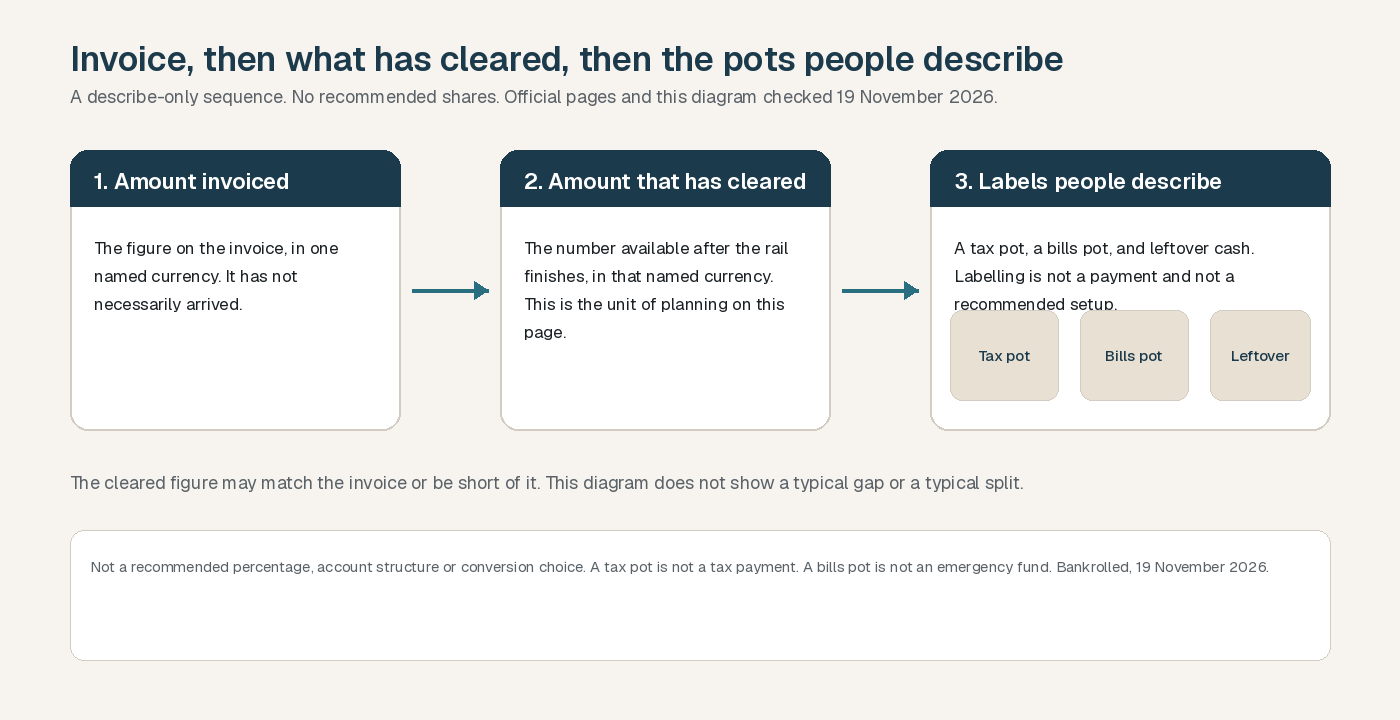
The live cleared-amount guide puts it this way: the cleared amount in the stated currency is the number you expect to see available after the rail finishes, in one named currency. Not “about that in my home currency after FX”. Not “whatever is left after the payer’s bank and two correspondents take a cut”.
That definition, checked on the live page on 19 November 2026, is the unit of planning this guide uses. An unpaid invoice is not cash that can be moved. A set-aside described as a share of “what I invoiced” can overstate the cash that is actually there if the credit later arrives short. This page does not reprint invoice wording, receiving-rail setup or fee tables.
How do people describe a tax pot next to a bills pot?
After a lump has cleared, people commonly talk about three separate jobs for that cash. The labels are a way of talking about the money, not a recommended account structure and not a legal status.
- A tax pot is a label people give to cash they are not treating as spendable because they expect a later tax bill or instalment.
- A bills pot is a label for known living or business costs that come due whether or not the next lump has arrived.
- Whatever is left is sometimes described as spendable, or as a buffer for thin months.
Labelling cash as a tax pot is not a tax payment, and it does not by itself legally restrict the funds. A bills pot is not an emergency fund: see emergency cash when ISA and FSCS do not apply. The split is also not the same as operating cash versus a longer buffer versus investment cash, covered in operating cash vs investment cash when you hold two currencies.
A frequent next question is how much to set aside. There is no single percentage. The amount depends on where the person is tax resident, how they work, their profit, social contributions, and whether they have collected VAT, GST or similar on behalf of a tax authority. This page does not give a figure, and it does not treat blog or forum shares as a rate for the reader.
When in the sequence do people say the set-aside happens?
People who describe a set-aside usually start from when the payment has cleared, not when the invoice was sent. An unpaid invoice is not cash that can be moved, and the credit can differ from the invoice.
On the UK side, a dated official example makes the same timing point for tax records. HMRC’s cash-basis pages, checked on 19 November 2026, say that with cash basis you only record income when you receive money, and that cash basis is the default for sole traders and partnerships without corporate partners from the 2024 to 2025 tax year. The records guide’s example records an invoice dated 15 March 2024, received on 30 April 2024, as income on 30 April 2024 in the 2024 to 2025 tax year. That is HMRC’s illustration, not an instruction to adopt cash basis, and not a rule for every country.
What happens when the invoice currency is not the tax or bills currency?
When the currency that arrives is not the currency of a later tax bill, or of rent and supplies, people ask whether to hold the set-aside in the currency that landed or to convert it into the currency of the later bill. Both are descriptions of a choice. This page does not recommend either, or a place to hold the money. Conversion also changes the local-currency amount that later records may need to show. The official conversion rule, where one exists, is residence-specific. This page does not state a global rule, and it does not treat any single HMRC page as a general “use this rate” instruction for all UK freelance foreign-currency income.
For people who file a US tax return, the IRS page on yearly average currency exchange rates, checked on 19 November 2026, says: “You must express the amounts you report on your U.S. tax return in U.S. dollars.” In general, use the exchange rate prevailing (the spot rate) when you receive, pay or accrue the item. The same page says the IRS “has no official exchange rate” and that, generally, “it accepts any posted exchange rate that is used consistently.” Those sentences are US reporting rules, not a recommendation of when to convert cash for bills.
Which official calendars show up in these stories?
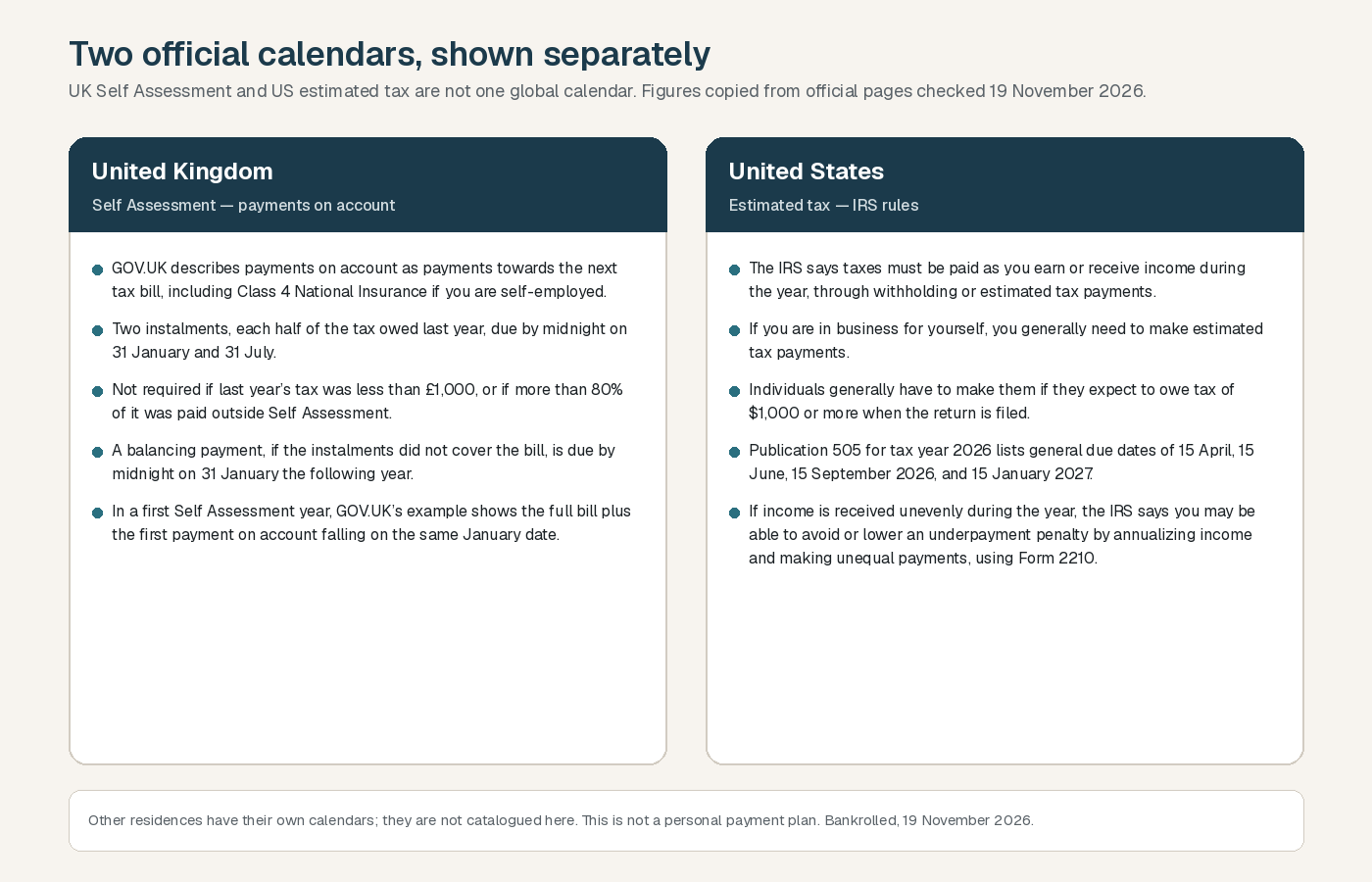
Instalment and estimated-tax calendars are one reason a tax pot appears in these descriptions: a bill can fall due in a month when no new lump has arrived. The dates below are what the official pages said on 19 November 2026. They are country-specific rules, not a global calendar, and not a personal payment plan.
United Kingdom: payments on account
GOV.UK’s page on payments on account, checked on 19 November 2026, says they are payments towards the next tax bill, including Class 4 National Insurance if you are self-employed. They spread the cost in two instalments, each half of the tax owed last year, due by midnight on 31 January and 31 July, unless last year’s tax was less than £1,000 or more than 80% of it was paid outside Self Assessment.
If the instalments do not cover the bill, GOV.UK describes a balancing payment due by midnight on 31 January the following year. In a first Self Assessment year, the page’s official example puts the full bill for the year just ended and the first payment on account on that same January date (£3,000 plus £1,500, so £4,500 on 31 January 2025 in the example). A separate GOV.UK page covers claims to reduce payments on account if profits or other income go down; this page does not walk through that process.
United States: estimated tax
The IRS estimated-tax page, checked on 19 November 2026, says taxes must be paid as you earn or receive income during the year, through withholding or estimated payments, and that “if you are in business for yourself, you generally need to make estimated tax payments.” Individuals, including sole proprietors, partners and S corporation shareholders, generally have to make them if they expect to owe tax of $1,000 or more when their return is filed.
Publication 505 for tax year 2026, checked the same day, lists general US due dates of 15 April, 15 June and 15 September 2026, and 15 January 2027, for four payment periods, with a Saturday, Sunday or legal holiday rule. Those dates are US rules, not advice to a non-US reader. The estimated-tax page also says that if income is received unevenly during the year, you may be able to avoid or lower an underpayment penalty by annualizing your income and making unequal payments, using Form 2210. The IRS “About Form 2210” page, checked the same day, says the form is used to see if that penalty applies and, if it does, to figure the amount.
Other tax residences have their own instalment or provisional-tax calendars; this page does not catalogue them. Who taxes the income is a residence question, not a client-location question: see tax residence vs where your client is. Paperwork a US client asks for before paying, which can change what arrives, is a separate issue; see W-8BEN for freelancers living abroad.
Frequently asked questions
What is irregular or lumpy income from cross-border clients?
Income that arrives in uneven amounts and on uneven dates, often with a gap between invoice and credit, and often in a currency that is not the one used for tax or bills. It is a different pattern from a monthly salary where tax is already withheld. There is no single official definition.
When do people treat a foreign-currency payment as money they can set aside?
People who describe a set-aside usually start from the cleared amount: the number available after the rail finishes, in the named currency — not the invoice total, and not a home-currency guess.
What does “cleared amount” mean?
The number you expect to see available after the rail finishes, in one named currency. The live guide to the cleared amount in the stated currency is the source of that definition.
What is a tax pot? What is a bills pot?
A tax pot is a label people give to cash they are not treating as spendable because they expect a later tax bill or instalment. A bills pot is a label for known living or business costs that come due whether or not the next lump has arrived. Labelling cash is not a recommended account setup.
Is a tax pot the same as paying the tax authority?
No. Labelling cash as a tax pot is not a tax payment, and it does not by itself legally restrict the funds or transfer them to a tax authority.
Is there a standard percentage freelancers set aside for tax?
No. There is no single figure. The amount depends on tax residence, how the person works, profit, social contributions, and whether they have collected VAT, GST or similar on behalf of a tax authority. This page does not give a percentage.
Why do people describe setting money aside when the payment clears, not when they invoice?
An invoiced amount has not necessarily arrived, and the credit can be short of the invoice after fees or the wrong rail. A set-aside described as a share of what was invoiced can overstate the cash that is actually there.
Do people hold the set-aside in the invoice currency or convert first?
Both are described when the invoice currency and the tax or bills currency differ. This page does not recommend either, and it does not pick an exchange rate.
What are payments on account on a UK Self Assessment bill?
GOV.UK describes them as payments towards the next tax bill, including Class 4 National Insurance if you are self-employed, due by midnight on 31 January and 31 July. Each payment is usually half of the tax owed last year, unless last year’s tax was less than £1,000 or more than 80% of it was paid outside Self Assessment.
What does the IRS say about estimated tax when income is received unevenly?
The IRS estimated-tax page says that if you are in business for yourself, you generally need to make estimated tax payments, and that individuals generally have to make them if they expect to owe tax of $1,000 or more. If income is received unevenly during the year, the same page says you may be able to avoid or lower an underpayment penalty by annualizing your income and making unequal payments, using Form 2210.
Is this the same as setting a USD day rate when costs are in another currency?
No. That guide is about quoting a price when costs are in another currency. This page is about what people describe doing with a lump after it has cleared.
Does the client’s country decide which tax pot to fill?
Usually tax residence, not the client’s country, is the starting point for where income tax is due. Withholding or paperwork the client asks for is a separate issue. See tax residence vs where your client is, and W-8BEN for freelancers living abroad if a US client asks for a form.
What this article is not
It is not a recommended percentage, and it is not financial, tax or legal advice. It is not a pricing guide — see how to set a USD day rate when costs are in another currency, including the note that a fictional planning figure in that worked example is not a rate for the reader. It is not tax-residence advice; see tax residence vs where your client is. It is not an invoicing or rails guide; see the cleared amount in the stated currency and getting paid in one country while you live in another. It is not a deposit-protection or emergency-fund guide, and it is not a VAT or GST explainer.
Sources
- GOV.UK, Payments on account — 31 January and 31 July, £1,000 and 80% exceptions, balancing payment, first-year January example. Rechecked 19 November 2026. Pointer only: Claim to reduce payments on account (published 9 May 2024), checked the same day.
- GOV.UK, Cash basis and What records to keep — default cash basis from 2024 to 2025; invoice of 15 March 2024 received 30 April 2024. Checked 19 November 2026.
- IRS, Estimated taxes — rechecked 19 November 2026 — together with Publication 505 (tax year 2026), About Form 2210, and Yearly average currency exchange rates, all checked the same day.
- Bankrolled pages linked in the article, each HTTP 200 on 19 November 2026, including the cleared-amount definition (last updated 23 October 2026) and how to set a USD day rate when costs are in another currency (last updated 10 October 2026).
Still got a question? Ask Bankrolled and get a quick answer from our guides.
