

If you are not a US citizen, live outside the US and hold US shares or US-listed funds, the US may still have a claim on those holdings when you die. Many people call it inheritance tax or a death tax; the US calls it estate tax. It is a separate question from the dividend tax taken each year, which our guide to US dividend withholding for non-US investors covers. This guide explains when the US estate tax reaches a non-US person’s US shares and funds, the US$60,000 filing threshold, what a tax treaty can change, and why the legal home of a fund matters more than where your broker is.
This is general information, not tax, legal or estate-planning advice. Estates are fact-specific, and if you or your family hold US assets you should speak to a cross-border adviser. Rules and figures were checked on 12 November 2026 against the IRS and other official sources listed at the end, with the IRS revision of each document noted. Where we could not confirm a point from an official source, we say so in the text.
Last updated 12 November 2026. This piece sits in the Grow section.
The short answer
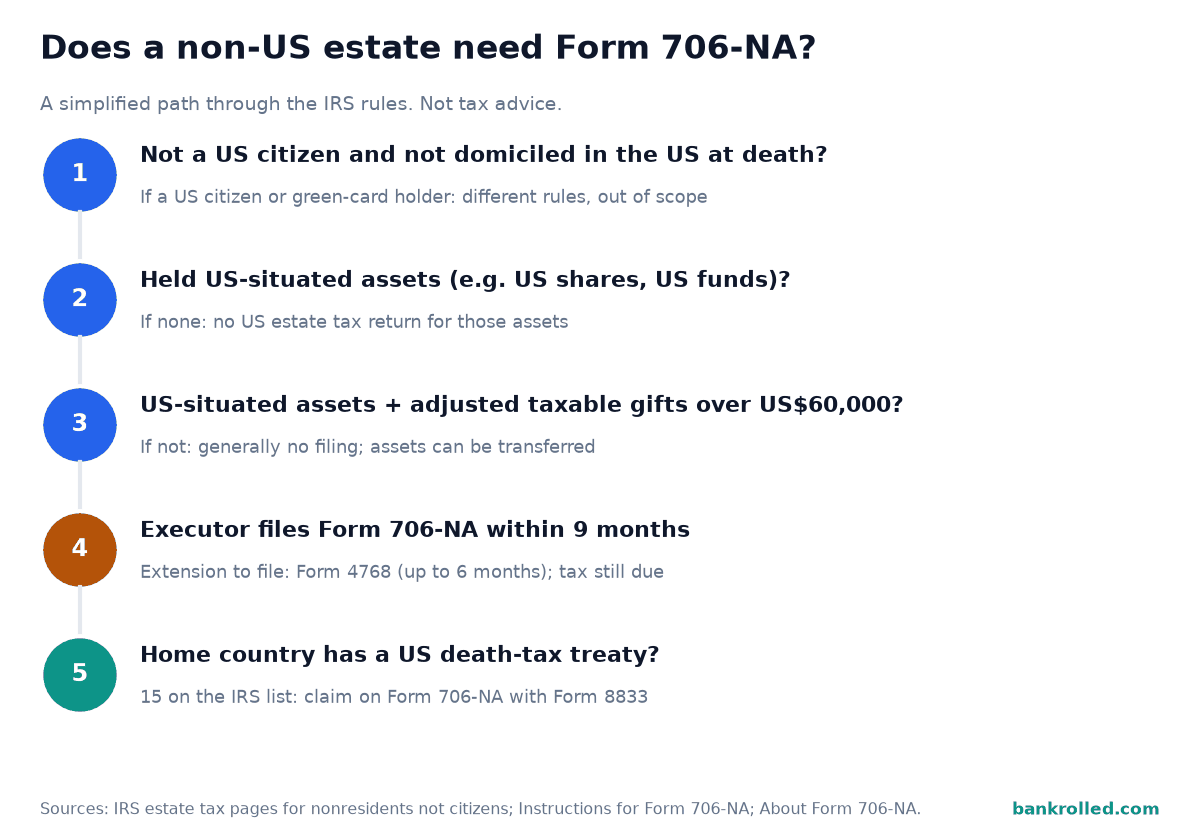
The US taxes the estate of someone who was neither a US citizen nor domiciled in the US only on assets situated in the US. Shares of US corporations count, wherever the certificates or the broker are; shares of non-US corporations generally do not. If those US-situated assets, plus certain lifetime taxable gifts, are worth more than US$60,000 at death, the executor must file Form 706-NA within nine months. A death-tax treaty can change the answer.
Who counts as a “non-resident not a citizen”
For estate tax, what matters is domicile, not income-tax residence. The IRS instructions for Form 706-NA say a person acquires a domicile in a place “by living there, for even a brief period of time, with no definite present intention of later moving”. They also say a person “may be a U.S. resident for income tax purposes yet be considered a nonresident for estate tax purposes”. So the tests you may know from income tax, or from our guide to tax residence versus where your client is, are not the same test.
This guide is about people who were neither US citizens nor domiciled in the US at death. US citizens and green-card holders follow different rules and are out of scope here. The W-8BEN you give your broker is an income-tax form; it does not settle your estate tax position.
Which assets count as US-situated
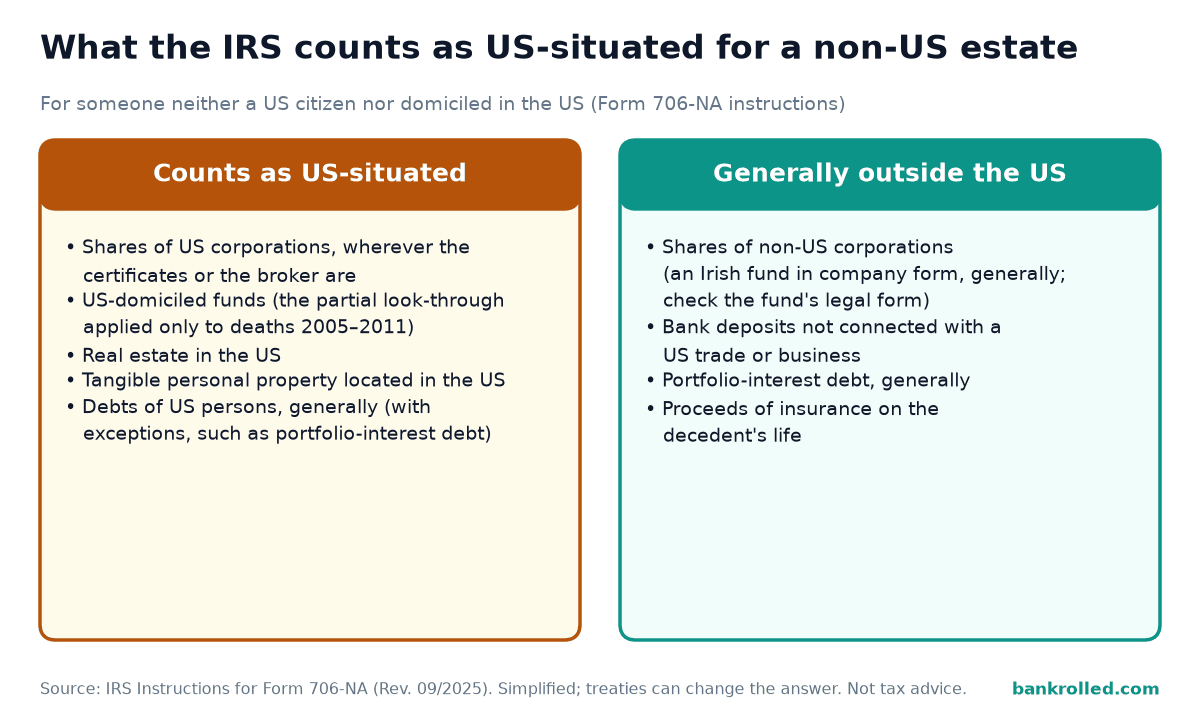
The IRS says US-situated assets include “stock of corporations organized in or under U.S. law, even if the nonresident held the certificates abroad or registered the certificates in the name of a nominee”. The Form 706-NA instructions put the general rule this way: “no matter where stock certificates are physically located, stock of corporations organized in or under U.S. law is property located in the United States, and all other corporate stock is property located outside the United States.”
| Asset | IRS treatment for a non-resident non-citizen | Where the IRS says it |
|---|---|---|
| Shares of US corporations | US-situated, wherever held | Form 706-NA instructions, “Stock”; IRS nonresident estate page |
| Shares of non-US corporations | Outside the US | Form 706-NA instructions, “Stock” |
| Real estate and tangible personal property in the US | US-situated if physically located there | Form 706-NA instructions |
| Deposits with US banks not connected with a US trade or business | Outside the US | Form 706-NA instructions, “Deposits” |
| Debt that would qualify for the portfolio-interest exemption | Generally outside the US | Form 706-NA instructions, “Debt obligations outside United States” |
| Insurance proceeds on the decedent’s life | Outside the US | Form 706-NA instructions, “Insurance proceeds” |
US-domiciled ETFs and funds
A US-domiciled ETF or mutual fund is generally a US entity, so its shares fall under the US stock rule. The Form 706-NA instructions describe a partial look-through for a regulated investment company (RIC), which is how US funds are usually organised: “For an NRNC decedent who died after 2004 and before 2012, a portion of stock in a RIC is treated as property located outside the United States”. The instructions describe that look-through only for deaths in that window, so for a death today they give no such carve-out.
Irish-domiciled ETFs
Many non-US investors hold the same US market exposure through funds domiciled in Ireland. Under the IRS stock rule above, shares of a corporation that is not organised under US law are property outside the US, so an Irish fund set up as a company is generally outside US estate tax even if it holds US shares. Davy, an Irish broker, says in a guide for its clients (a practitioner view, not an official source) that an Irish-domiciled fund invested in US assets does not create US estate tax exposure “as your holdings are in the Irish fund, not directly in the US-based assets”.
Two cautions. First, the IRS rule is about corporate stock, and not every Irish fund is a company: some are unit trusts or other contractual structures. We did not find an official source on how each legal form is treated, so check the fund’s legal form and take advice rather than assuming it is exempt. Second, fund domicile also changes the dividend tax inside the fund: the US–Ireland income tax treaty generally sets 15% on dividends where the fund qualifies. Our guide to accumulating versus distributing ETFs for non-residents works through that, so we do not repeat it here. This is how the IRS rule works, not a suggestion to switch funds; speak to a cross-border adviser about your own holdings.
The $60,000 filing threshold and the $13,000 credit
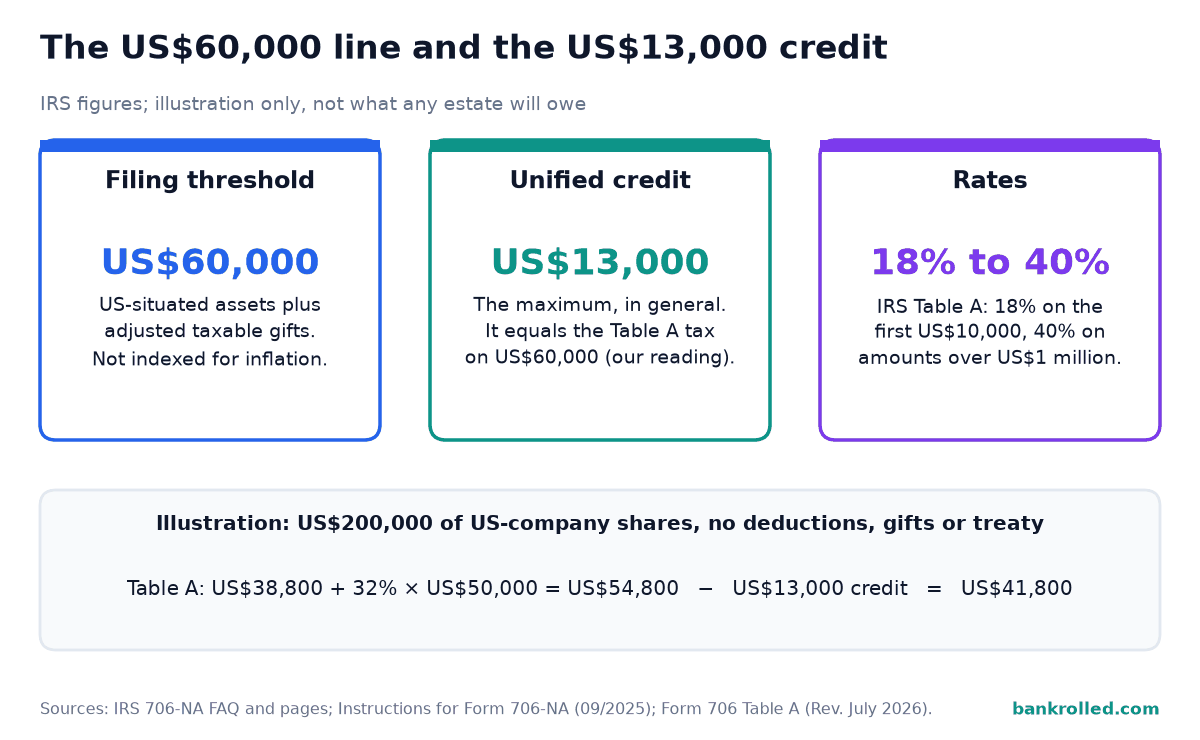
The IRS says the executor can generally transfer US-situated assets without filing if those assets, together with the decedent’s adjusted taxable gifts, do not exceed US$60,000. If the US$60,000 threshold is exceeded, Form 706-NA must be filed. The IRS also says “the filing threshold for Form 706-NA is not indexed for inflation”.
The US$60,000 is a filing threshold, not an allowance. The Form 706-NA instructions say that, in general, “the maximum unified credit is $13,000”. On Table A, the unified rate schedule in the IRS instructions for Form 706, the tax on US$60,000 is exactly US$13,000. Our reading of the two is that the credit cancels the tax on roughly the first US$60,000 of the taxable estate. If you measure your portfolio in pounds, euros or rupees, remember that the threshold is in US dollars; see which currency to measure your portfolio in.
How the tax is worked out
Non-resident estates use the same Table A rate schedule as US estates. The Form 706-NA instructions say to use Table A from the version of the Form 706 instructions that matches the date of death. In the current version (Rev. July 2026, for decedents dying after 31 December 2025), the rate starts at 18% on the first US$10,000 and rises in bands to 40% on amounts over US$1,000,000, where the tax is US$345,800 plus 40% of the excess.
Deductions are limited. The IRS says deductible expenses generally include funeral expenses, administration expenses of the estate, claims against the estate, unpaid mortgages and liens, and certain uncompensated losses. Charitable and marital deductions have their own conditions, covered below for spouses.
Illustration (not a quote or advice). Suppose the only US-situated asset is US$200,000 of US-company shares, with no deductions, gifts or treaty, and a death in 2026. Table A gives a tentative tax of US$38,800 + 32% × US$50,000 = US$54,800. Less the US$13,000 maximum unified credit, that leaves US$41,800. This ignores deductions, treaties, US state taxes and gifts, and it is not what any real estate will owe.
Treaties can change the answer
The IRS says treaties “often provide more favorable tax treatment”. A death-tax treaty can take assets out of US tax altogether, or change how the tax is worked out.
Which countries have a US estate tax treaty
The IRS lists death-tax treaties in effect with 15 countries: Australia, Austria, Canada (through the estate tax article of the US–Canada income tax treaty), Denmark, Finland, France, Germany, Greece, Ireland, Italy, Japan, the Netherlands, South Africa, Switzerland and the United Kingdom. India, Singapore, the UAE and many other countries are not on the IRS list. We have not checked every treaty text, so “not on the IRS list” is as far as we go.
Worked case: the US–UK treaty
The US–UK estate and gift tax convention, signed on 19 October 1978, is set out in UK law as SI 1979/1454. Article 4 decides where a person is domiciled for the treaty, with tie-breaker rules for someone treated as domiciled in both countries. Article 5(1)(a) says that if the decedent was domiciled in one of the two countries at death, property “shall not be taxable in the other State”, apart from real estate (Article 6) and business assets of a permanent establishment (Article 7). That does not apply if the decedent was a national of that other country.
Article 8(5) adds a cap for a UK national who was neither domiciled in nor a national of the US: the US tax is limited to what would have been charged had the person become domiciled in the US just before death. The Form 706-NA instructions confirm this alternative calculation.
One point we could not confirm: the treaty refers to being domiciled in the UK “in accordance with the law of the United Kingdom”, and the UK replaced domicile with long-term residence rules for inheritance tax from 6 April 2025. We found no HMRC or IRS guidance on how the treaty test applies now, so take advice on this.
How a treaty claim is made
The IRS FAQ says to list the estate’s US assets in Schedule A of Form 706-NA but show no values for those exempt under a treaty, and to attach Form 8833 to say the return position is treaty-based. The IRS page for Form 706-NA added a note on 11 November 2026: attach Form 8833 to Form 706-NA when reporting items based on a death-tax treaty or protocol.
What the executor has to do
- File on time. The IRS says Form 706-NA must be filed within 9 months after the date of death unless an extension was granted. The current form is Rev. August 2025, for decedents dying after 31 December 2024.
- Extensions. An extension to file can be requested on Form 4768 for up to six months, but the IRS says the correct tax is still due by the original due date.
- The transfer certificate. The IRS issues a transfer certificate when it is satisfied that the estate’s US tax, if any, has been fully discharged or provided for. It says a certificate is not required for property administered by an executor or administrator appointed, qualified and acting within the US. How a particular broker handles the account while that happens is up to the broker, so ask it.
- Closing letter fee. The IRS page for Form 706-NA says the estate tax closing letter fee rose to US$76 after 26 October 2026. That fee changes, so check the IRS page.
For what can happen to an account when its owner moves country, see what happens to your brokerage account when you move country.
Spouses: no automatic exemption
Many people assume everything can pass to a spouse tax-free. For these estates, the Form 706-NA instructions say: “Unless a treaty allows otherwise, you may only take a marital deduction if the surviving spouse is a U.S. citizen or if the property passes to a qualified domestic trust (QDOT)”. The IRS also says the executor of a non-resident non-citizen cannot make a portability election, so an unused amount cannot be passed to the surviving spouse.
Your home country may tax the same assets
The US is not the only country that may tax an estate. In the UK, for example, the domicile rules for inheritance tax were replaced from 6 April 2025 by long-term UK resident rules. GOV.UK says a person is a long-term UK resident if they were UK tax resident for 10 or more of the previous 20 tax years, and that the status can continue for up to 10 tax years after leaving the UK. Check your own country’s rules, and ask an adviser how any double-tax relief works.
A checklist before you hold US-listed assets
These are questions to ask, not recommendations:
- What is the total value of your US-situated assets, including US shares and US-domiciled funds, compared with US$60,000?
- Where is each fund domiciled, and what is its legal form?
- Is your country of domicile on the IRS list of death-tax treaties?
- Does your family know which broker holds what, and who would act as executor?
- Is anyone in your family a US citizen or green-card holder? The answers are different for US persons.
- Have you spoken to a cross-border adviser about your home country’s rules as well as the US?
For the wider set-up, see a brokerage account when you are not in one tax jurisdiction and a low-cost portfolio when you are not in one tax jurisdiction.
Frequently asked questions
Do non-US citizens pay US estate tax on US stocks?
They can. If the person was neither a US citizen nor domiciled in the US, the US taxes their estate on US-situated assets, which include shares of US corporations. A treaty can change this.
What is the US estate tax threshold for non-residents?
Form 706-NA must be filed if US-situated assets plus adjusted taxable gifts exceed US$60,000. The IRS says the threshold is not indexed for inflation. The maximum unified credit is generally US$13,000.
Does it matter where my broker is, or where the share certificates are held?
No. The IRS says stock of US corporations is US property no matter where the certificates are physically located or whose name they are registered in.
Are US-domiciled ETFs and mutual funds caught?
Shares of a US fund are generally US-situated. The Form 706-NA instructions describe a partial look-through for regulated investment companies only for deaths after 2004 and before 2012.
Are Irish-domiciled ETFs caught?
Under the IRS rule, shares of a non-US corporation are outside the US, so an Irish fund in company form is generally outside US estate tax. Not every Irish fund is a company, so check the fund’s legal form and take advice.
What rates apply?
The IRS Table A rate schedule, from 18% on the first US$10,000 up to 40% on amounts over US$1,000,000, less the US$13,000 maximum unified credit in general. Use the Table A version for the year of death.
Who files, and when?
The executor files Form 706-NA within nine months of death. Form 4768 can extend the filing deadline by up to six months, but the tax is still due on the original date.
Does a spouse exemption apply?
Not automatically. Unless a treaty allows otherwise, the marital deduction needs a US-citizen spouse or a qualified domestic trust (QDOT). The executor cannot elect portability.
Does a tax treaty help?
It can. The IRS lists 15 countries with death-tax treaties, including the UK, Ireland, Canada and Japan. Treaty claims are made on Form 706-NA with Form 8833 attached.
What is a transfer certificate?
A document the IRS issues once it is satisfied the estate’s US tax has been discharged or provided for. It is not required for property administered by an executor appointed and acting within the US.
What about RSUs from a US employer?
RSUs that have already vested into shares of a US corporation are US corporate stock under the same rule. We did not find IRS guidance on unvested awards for this edition, so they are out of scope; ask an adviser.
How does this connect to dividend withholding?
The same choice of fund domicile affects both the dividend tax inside the fund and whether the holding is US-situated. See our guide to US dividend withholding.
Does my home country also tax it?
Possibly. In the UK, long-term UK resident rules have applied to inheritance tax since 6 April 2025. Check your own country’s rules.
What this guide does not cover
It is not tax, legal or estate-planning advice, and it does not tell you what to buy or sell. It does not cover US citizens, green-card holders or people who have given up US citizenship, gift tax in detail, trusts, US real estate planning, life insurance strategy, US state estate taxes, the PFIC rules that apply to US persons, unvested RSUs, ADRs, or interests in US partnerships and LLCs. Estates are fact-specific; speak to a cross-border adviser.
Sources
- IRS: Frequently asked questions on estate taxes for nonresidents not citizens of the United States, page reviewed 20 September 2026, checked 12 November 2026
- IRS: Estate tax for nonresidents not citizens of the United States, page reviewed 28 June 2026, checked 12 November 2026
- IRS: Some nonresidents with US assets must file estate tax returns, page reviewed 27 June 2026, checked 12 November 2026
- IRS: Instructions for Form 706-NA (Rev. 09/2025), page reviewed 30 April 2026, checked 12 November 2026
- IRS: Instructions for Form 706, Table A unified rate schedule (Rev. July 2026), checked 12 November 2026
- IRS: Form 706-NA (Rev. August 2025), checked 12 November 2026
- IRS: About Form 706-NA, recent developments, page reviewed 10 November 2026, checked 12 November 2026
- IRS: About Form 8833, checked 12 November 2026
- IRS: About Form 4768, checked 12 November 2026
- IRS: Estate and gift tax treaties (international), page reviewed 8 September 2026, checked 12 November 2026
- IRS: Transfer certificate filing requirements for the estates of nonresidents not citizens of the United States, page reviewed 5 May 2026, checked 12 November 2026
- legislation.gov.uk: Double Taxation Relief (Taxes on Estates of Deceased Persons and on Gifts) (United States of America) Order 1979, checked 12 November 2026
- GOV.UK: Inheritance Tax if you’re a long-term UK resident, checked 12 November 2026
- IRS: United States–Ireland income tax treaty, checked 12 November 2026
- Davy: The impact of US Federal Estate Tax for Irish investors (practitioner guide, not an official source), checked 12 November 2026
Still got a question? Ask Bankrolled and get a quick answer from our guides.
